
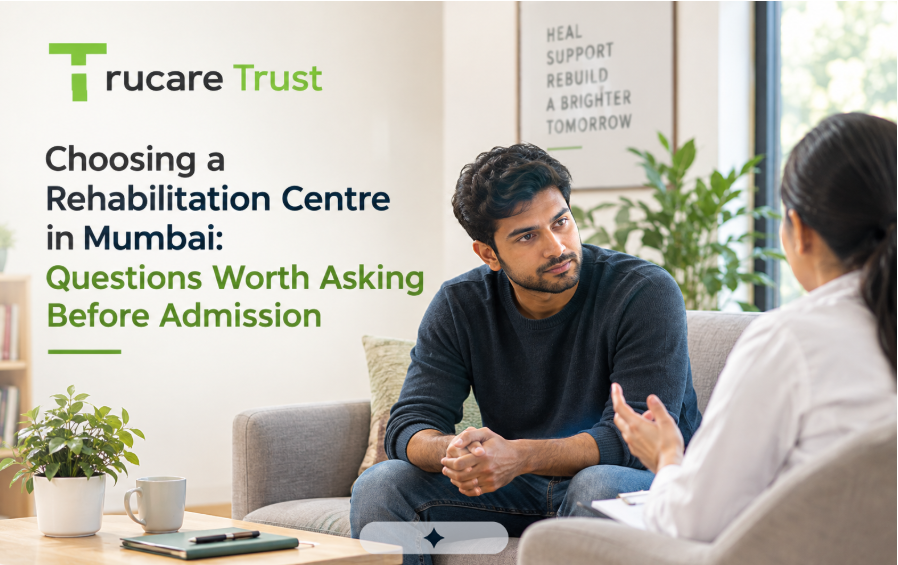
A rehabilitation centre is usually contacted after the family has already tried several things on its own.
Alcohol has been removed from the house. Money has been restricted. A relative has stayed with the person for a few days. Promises have been made after particularly bad episodes. Sometimes there has already been an earlier treatment attempt.
By the time admission is discussed, everybody wants a quick answer.
That is exactly when a family should slow down enough to ask better questions.
India’s substance-use figures explain why there cannot be one standard rehabilitation plan. The 2019 national survey conducted by the National Drug Dependence Treatment Centre at AIIMS, New Delhi estimated around 16 crore alcohol users, 3.1 crore cannabis users and 2.26 crore opioid users in India. These groups overlap in places, and within each group the severity of the problem varies enormously.
A person drinking heavily from morning is not presenting the same treatment problem as someone smoking cannabis every evening. Heroin dependence needs another assessment. Gambling and gaming disorders do not involve a drug at all.
A rehabilitation centre in Mumbai should establish those differences before deciding what treatment is appropriate.
Start with what happened during the previous seven days
Families sometimes arrive with a ten-year history of the problem but forget the details that matter immediately.
What was used yesterday?
When was the last drink?
Has the person slept?
Have they eaten?
Are medicines being taken?
Has there been vomiting, shaking, unusual confusion, severe anxiety or an episode of unconsciousness?
The recent pattern can determine what needs to happen first.
Alcohol illustrates the point. WHO describes alcohol as a psychoactive, toxic and dependence-producing substance. Someone with significant physical dependence may require medical assessment before simply stopping.
That is not an argument for continuing alcohol.
It is an argument against amateur withdrawal management.
Do not judge treatment quality from the room first
Families understandably inspect photographs.
They want to know whether the accommodation is clean, whether rooms are shared and whether food will be acceptable.
Those are legitimate questions during a residential stay.
They are not the most important ones.
Ask who conducts the assessment. Ask who provides counselling. Find out what happens when psychiatric symptoms appear. Ask how prescription medicines are stored and administered. If somebody becomes medically unwell at night, what is the process?
There should be specific answers.
“Everything is taken care of” is not a specific answer.
The national treatment gap should make centres more accountable, not less
The AIIMS-NDDTC survey estimated that more than 5.7 crore Indians needed help for harmful or dependent alcohol use.
The number is striking enough on its own.
More concerning was the treatment gap reported by the survey. Only a small proportion of people with alcohol dependence had ever received formal treatment.
That means many families entering addiction services have little idea what good treatment should look like. They are buying something they have never bought before at a time when judgement is being affected by urgency.
A centre should make the process easier to understand rather than use that uncertainty to make exaggerated promises.
Counselling should eventually become very specific
Consider two people who both drink every evening.
The first drinks after intense work pressure and rarely drinks on holidays.
The second begins drinking whenever he is alone.
The amount could be similar.
The relapse problem is not.
Treatment needs enough time and skill to uncover those differences.
Someone may discover that salary day is repeatedly followed by drug use. Another person relapses whenever contact resumes with one particular group. A third person has been using cannabis as a sleep aid for years and has never addressed the sleep problem itself.
That is much more useful than repeating that alcohol and drugs are harmful.
They already know.
What is happening inside the family?
Addiction can change family behaviour almost as much as it changes the person using the substance.
One relative clears debts.
Another monitors every phone call.
A spouse repeatedly tells the employer that the person is sick.
Arguments about money become normal.
Eventually nobody knows where support ends and rescue begins.
Families comparing rehabs centre in Mumbai should ask whether family sessions or discharge discussions are part of the programme.
There is practical work to do before somebody returns home.
Who controls access to large amounts of money initially?
What happens if the person does not attend follow-up treatment?
How will the family respond if substance use resumes?
Which behaviours will no longer be hidden from employers or relatives?
These decisions are much harder to make in the middle of another crisis.
Treatment should survive contact with ordinary life
A person may remain substance-free throughout residential treatment.
That tells us something.
It does not tell us what happens three days after discharge when the person receives a message from the same friend they used drugs with for five years.
Or when salary reaches the bank.
Or when they attend the first wedding where everyone at the table is drinking.
Rehabilitation should prepare for these ordinary moments because this is where recovery actually has to operate.
No centre can guarantee what another person will do six months later.
It can assess carefully, treat responsibly, help identify relapse patterns and build a serious continuing-care plan.
Those are far more useful things to judge than a promise of “100% recovery”.