
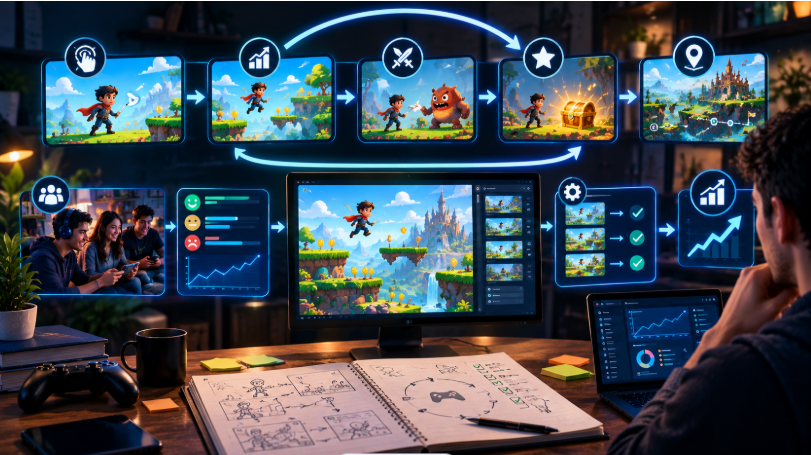
A core loop is the simple action a player repeats over and over while playing your game. It’s what they’ll do hundreds or thousands of times. Everything else in game design, the progression systems, the story, the art, the complexity, all of it exists to support and evolve that core loop. Yet most struggling games don’t actually have a clear core loop. They have several competing actions, some half-formed systems players don’t quite understand, a general sense of “do stuff” without clarity on what that stuff actually is. Games with genuinely clear, engaging core loops don’t struggle to find players. People instinctively understand what they’re supposed to do and why doing it feels good. Building your entire game around a core loop that actually works is the single most important design decision you can make.
What A Core Loop Actually Is
The Simplest Definition
A core loop is the repeatable action at the heart of your game. In a platformer, it’s jump and move. In a puzzle game, it’s identify the pattern and solve it. In an action game, it’s approach, attack, evade. In a management game, it’s resource allocation and decision-making. That core action is what players do constantly throughout your game. Everything else branches from there.
The clarity of this loop matters enormously. If a player can’t explain in one sentence what the core action is, your loop probably isn’t clear enough. “Jump and avoid obstacles” is clear. “Navigate a complex system of interconnected mechanics while managing multiple resources and responding to dynamic events” is not, even if that’s technically accurate.
Why It Matters More Than Everything Else
Players tolerate enormous limitations if the core loop is engaging. A game with basic graphics, simple story, and minimal features succeeds if the core action feels good. A game with brilliant art, complex systems, and enormous content fails if the core loop is frustrating or unclear. That’s not a coincidence, it’s recognition that players value moment-to-moment gameplay more than anything else.
This matters because you can’t fix a broken core loop by adding features. A game where the core action doesn’t feel satisfying won’t improve by adding progression systems, cosmetics, or story. All of those are supported by the core loop, but they can’t save a game where the fundamental action isn’t engaging. Conversely, a game with an engaging core loop can be quite minimal and still hold player attention.
Designing Your Core Loop
Start With One Clear Action
Don’t try to create a complex loop with multiple interacting systems. Start with a single action that’s easy to understand and easy to execute. One thing the player does repeatedly. That simplicity is strength, not limitation. Everything else builds from there, but the foundation needs to be simple enough for a player to grasp immediately.
This single action should be something the player will do hundreds of times, so it needs to be something that feels good repeatedly. An action that’s satisfying once but gets tedious fast isn’t a strong core loop. The action needs to have enough variation that repetition stays interesting, or at minimum, the satisfaction of doing it well needs to carry through repeated attempts.
Make That Action Feel Satisfying
Satisfaction comes from multiple sources. Immediate feedback matters, knowing that your action had an effect. The action should feel responsive, under your control, precise enough that skill improvement feels meaningful. Audio and visual polish matter, since pleasant sounds and smooth animation make an action feel good. The relationship between effort and reward matters, since disproportionate difficulty or reward feels off.
This is where iteration becomes crucial. You need to test the action repeatedly, watching how it actually feels, adjusting response time and feedback until it feels right. That refinement can take dozens of iterations, but it’s absolutely worth the effort because this action is what players will do thousands of times.
Create A Reason To Repeat
A satisfying action needs context for why someone would do it repeatedly. In a platformer, you’re moving toward the next challenge. In a puzzle game, you’re solving progressively harder problems. In a progression game, you’re advancing toward a goal. That reason provides context that transforms a single satisfying action into a repeatable loop worth engaging with.
The reason doesn’t need to be elaborate. Simple is often stronger than complex. “Survive as long as possible” is enough reason to repeat the same core action thousands of times. “Reach the end” is enough. “Get a higher score” is enough. The reason just needs to be clear and achievable through the core action.
Testing Whether Your Loop Actually Works
Watch Real Players, Don’t Ask Them
Set someone down in front of your game with no explanation. Watch exactly what they do. Note where they hesitate, where they seem confused, where they lose interest. That observation reveals far more than asking them what they think afterward. People’s answers about why they stop playing often differ from what their behavior actually shows.
Pay special attention to the moment someone truly understands the core loop. That moment often has a visible shift, where they stop tentatively experimenting and start engaging with confidence. Identifying exactly what triggered that shift tells you what needs to be clearer in your communication.
Identify Where People Stop Engaging
Some players will naturally drop off because your game isn’t for them. That’s fine. But if most players disengage at a specific point, that’s valuable data. Maybe the core action gets repetitive before adding new elements. Maybe difficulty spikes suddenly and becomes frustrating. Maybe progression stops feeling meaningful. That pattern reveals where your loop needs adjustment.
Iterate Based On Observation
Make adjustments based on what you observe, not on assumptions about what should work. If players consistently disengage at a specific point, that’s not a personal preference, that’s data suggesting a real problem. Test the adjusted version with new players and see if engagement extends. That observation-based iteration is far more reliable than trying to predict what will work.
A Practical Example of Core Loop Design
Crab Game demonstrates what happens when a game is built entirely around a clear, engaging core loop. The game’s success comes from understanding exactly what the core action is, making that action feel great to execute repeatedly, and building progressively around that foundation. The game shows how focusing obsessively on core loop quality produces something players genuinely want to return to.
Learning how to create a game with a clear, engaging core loop is genuinely the most important skill in game design, since everything else flows from that foundation.
Building Everything Else Around Your Core Loop
Once your core loop works, everything else should support and enhance it. Progression systems should feel like they evolve the loop rather than distract from it. Story beats should create context that makes the core action feel more meaningful. Art and audio should reinforce what makes the core action satisfying. Features should add depth without compromising clarity.
The trap is adding features that compete with the core loop. A game where multiple different actions are equally important creates confusion rather than depth. A game where progression systems overshadow the core action loses what made it engaging. The most successful games keep the core loop at the center, with everything else orbiting around it rather than competing for attention.
Common Core Loop Mistakes
A loop that’s too complex confuses players about what the core action actually is. A loop that depends on external systems rather than intrinsic satisfaction fails to engage players. A loop that doesn’t have clear variation runs out of interest quickly. A loop that’s polished poorly feels unsatisfying even if it’s mechanically sound.
The most common mistake is not recognizing that you have a clear loop problem. You think the game needs more features, more progression, more complexity. Often, the actual problem is that the core loop isn’t clear or satisfying enough. Adding complexity on top of a weak loop makes it worse, not better.
Final Thoughts
Creating a game with a clear, engaging core loop means starting simple, focusing obsessively on making one action feel genuinely satisfying, testing that action with real players, and iterating based on observation rather than assumption. That core loop is the foundation everything else builds on. A game with a perfect core loop but minimal features succeeds. A game with enormous features but a weak core loop fails. Design your core loop first, test it thoroughly, refine it until it’s undeniably engaging, and then build everything else around it. That focus on fundamental satisfaction produces games players genuinely want to return to.